
Industrial assets such as motors, turbines, compressors, gearboxes, and production equipment are central to continuous operations. Failures in these systems lead to downtime, safety risks, and rising maintenance costs. Even short disruptions can result in lost output, missed delivery schedules, and cascading equipment damage.
Predictive Maintenance Using AI for Industrial Assets
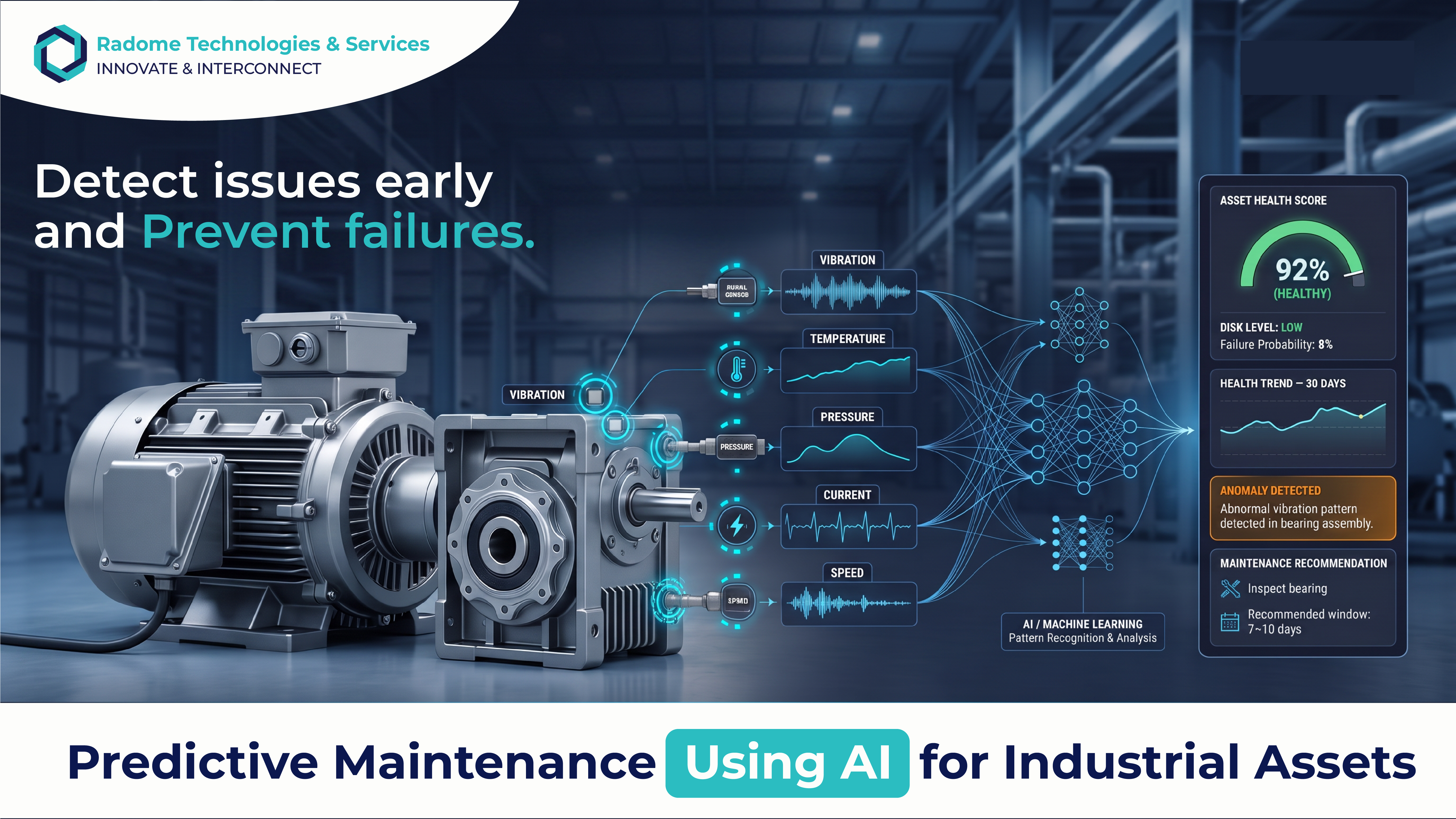
Table of Contents
- Introduction: AI-Driven Predictive Maintenance in Industrial Operations
- What Is Predictive Maintenance Using AI
- Why Predictive Maintenance Matters for Industrial Assets
- How Predictive Maintenance Using AI Works
- Industrial Use Cases
- Business Impact and ROI
- Challenges and Practical Considerations
- Choosing the Right Predictive Maintenance Approach
- How AI Predictive Maintenance Fits into a Long-Term Asset Strategy
- Conclusion
- FAQs
Introduction: AI-Driven Predictive Maintenance in Industrial Operations
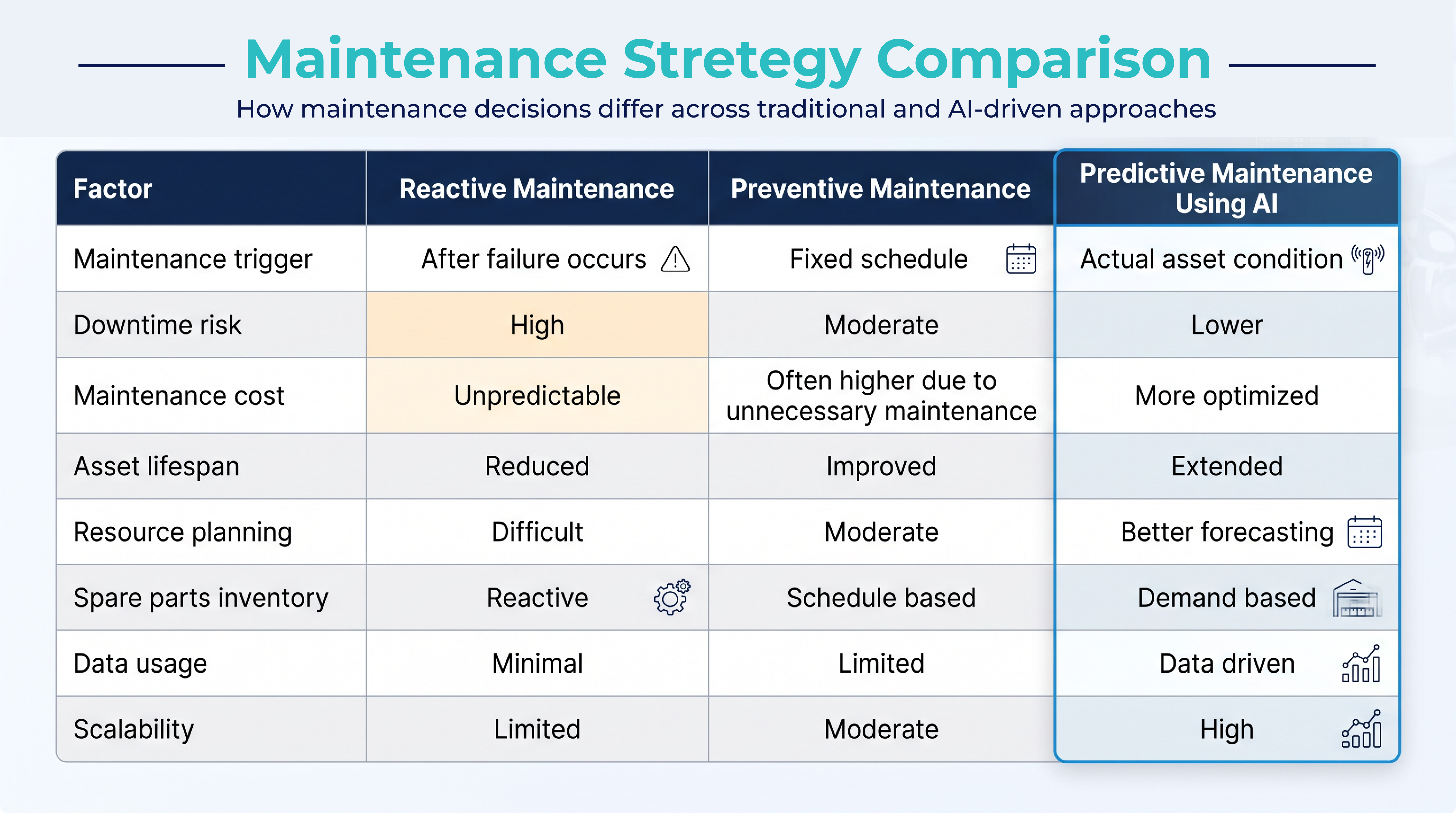
For decades, maintenance has relied on two dominant approaches:
reactive maintenance, where equipment is repaired after failure, and preventive maintenance, where components are serviced on fixed schedules. While both methods are still widely used, they are increasingly misaligned with modern industrial realities.
Equipment is more complex, operating conditions change more frequently, and the cost of downtime continues to rise.
Predictive maintenance using AI introduces a different approach. Instead of depending on time or usage intervals, it uses real operational data to assess asset health and forecast potential failures. This allows organisations to intervene before breakdowns occur, rather than responding after damage has already been done.
This page provides a strategic overview of how AI-based predictive maintenance works for industrial assets, why it matters, and how organizations can adopt it effectively.
What Is Predictive Maintenance Using AI
Predictive maintenance using AI combines condition monitoring, historical failure data, and machine learning models to estimate equipment health and failure probability.
Instead of relying only on:
- fixed inspection schedules,
- predefined alarm thresholds,
- or manual observations
AI-based systems learn what normal operating behaviour looks like for each asset and identify deviations that indicate abnormal patterns.
Most mechanical and electrical failures develop gradually. Bearings wear, vibration increases, temperatures drift, and efficiency declines long before a machine stops functioning. These early signals are often too subtle or too complex for human monitoring or rule-based systems to detect consistently. AI models are well suited to recognizing these patterns across large volumes of data.
At a conceptual level, predictive maintenance using AI shifts maintenance decision-making from time-based rules to condition-based insight. This transition is made possible through AI Predictive Maintenance Software, which analyses operational data, identifies anomalies, and provides actionable maintenance insights.
Why Predictive Maintenance Matters for Industrial Assets
Several forces are driving the adoption of industrial predictive maintenance:
Increasing asset complexity
Modern equipment includes advanced electronics, sensors, and control systems. Failures are rarely caused by a single factor and often involve interacting subsystems.
High cost of unplanned downtime
In asset-intensive industries, even one hour of downtime can cost tens or hundreds of thousands of dollars, depending on the process and sector.
Safety and compliance requirements
Unexpected failures increase the risk of hazardous incidents and regulatory violations, especially in energy, transportation, and heavy industry.
Pressure for operational efficiency
Organizations are expected to do more with fewer resources, making optimized maintenance. planning critical.
By using predictive maintenance using AI, organizations gain:
- earlier fault detection,
- improved maintenance scheduling,
- reduced secondary damage,
- more stable operations.
How Predictive Maintenance Using AI Works
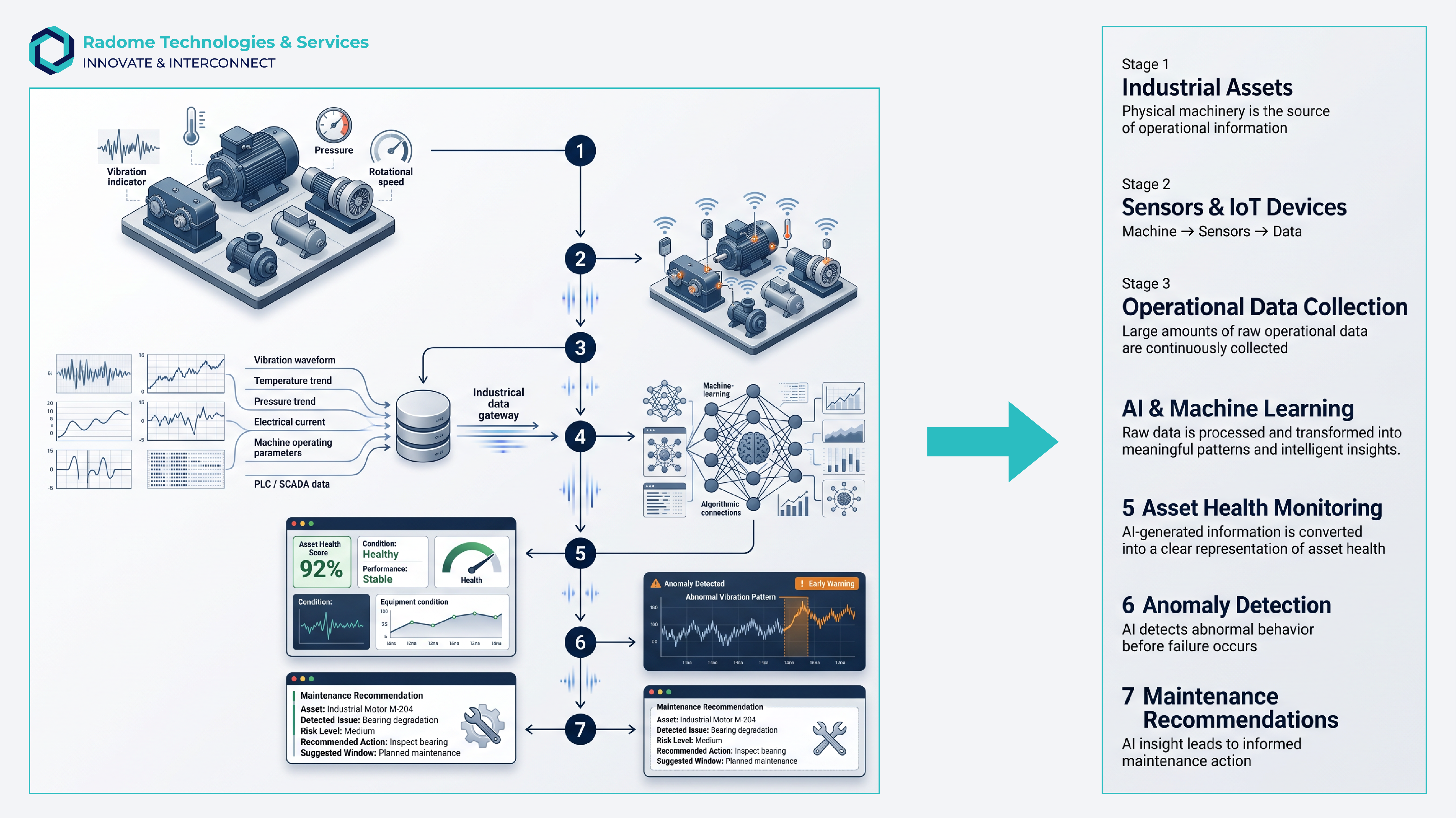
At a high level, predictive maintenance using AI follows a continuous loop:
Data acquisition
Operational data is collected from:
- vibration and acoustic sensors,
- temperature and pressure sensors,
- electrical current and voltage,
- control systems such as PLCs and SCADA.
Data preparation
Raw data is filtered, synchronized, and transformed into usable signals. This step is critical for ensuring reliable analysis.
Pattern analysis
Machine learning models analyse trends, relationships, and deviations in the data to detect abnormal behaviour and degradation patterns.
Insight generation
The system produces health indicators, risk scores, or failure likelihood estimates that can be interpreted by maintenance teams.
Maintenance action
Insights are used to plan inspections, part replacements, or operational adjustments before breakdown occurs.
This process operates continuously, allowing asset condition to be monitored over time rather than evaluated only during inspections.
Industrial Use Cases
Manufacturing
Motors, conveyors, CNC machines, and production lines benefit from vibration and load monitoring.
Example: rising vibration frequencies indicate bearing wear weeks before failure.
Energy and utilities
Turbines, generators, and transformers are monitored for thermal and performance changes.
Example: efficiency drift signals insulation degradation in generators.
Aerospace and transportation
Engines and hydraulic systems are tracked for deviations in pressure, temperature, and flow.
Example: subtle performance loss reveals early subsystem inefficiencies.
Heavy industry
Gearboxes, crushers, and compressors are monitored for torque and vibration patterns.
Example: gear tooth wear is detected before catastrophic failure.
These use cases illustrate how predictive maintenance using AI applies across different asset types, not just specific machines or industries.
Real-World Case Study: Scaling Predictive Maintenance in Manufacturing
A global automotive manufacturer operating production facility across 20 countries faced a common challenge: although its equipment generated large volumes of sensor data, maintenance teams lacked the resources to analyse it effectively. As a result, early signs of equipment degradation were often missed, increasing the risk of unplanned downtime.
The manufacturer implemented an AI-driven predictive maintenance platform to continuously monitor equipment health and identify anomalies before failures occurred. Instead of relying solely on scheduled inspections, maintenance teams received data-driven insights that helped prioritize interventions and schedule repairs during planned maintenance windows.
Reported Outcomes
- Up to 50% reduction in production downtime
- Tens of millions of dollars in downtime savings
- Return on investment (ROI) in less than three months
- Scalable deployment across multiple production facilities worldwide
This case demonstrates that the success of predictive maintenance depends not only on AI models but also on integrating predictive insights into everyday maintenance workflows. When supported by high-quality operational data and scalable AI platforms, organizations can improve asset reliability, reduce unplanned downtime, and achieve measurable business outcomes across industrial operations.
Business Impact and ROI
The business value of predictive maintenance using AI comes from several operational improvements:
Reduced downtime
- fewer emergency shutdowns
- less production loss
- more stable scheduling
Lower maintenance costs
- reduced spare part waste
- less overtime labour
- better maintenance prioritization
Extended asset life
- fewer catastrophic failures
- reduced secondary damage
- improved long-term reliability
Improved safety
- fewer sudden breakdowns
- reduced exposure to hazardous repairs
A single avoided failure on a critical asset can offset a significant portion of implementation costs. Over time, benefits accumulate through improved planning and reduced variability.
Challenges and Practical Considerations
Despite its advantages, predictive maintenance using AI is not without challenges:
- insufficient sensor coverage
- inconsistent data quality
- integration with legacy systems
- organizational resistance to new workflows
Predictive maintenance works best when:
- applied first to high-criticality assets,
- supported by clear data governance,
- aligned with existing maintenance processes,
- improved continuously over time.
Treating predictive maintenance as purely an IT initiative often leads to poor results. It must be embedded into operational practice.
Choosing the Right Predictive Maintenance Approach
Not all predictive maintenance solutions are suitable for every industrial environment. Organizations must consider:
- asset types and failure modes
- operating conditions
- data availability
- scalability requirements
- cybersecurity and governance
Evaluation should focus not only on analytics capability, but also on how insights are translated into maintenance actions. The effectiveness of a predictive maintenance strategy ultimately depends on selecting AI predictive maintenance software that aligns with asset criticality, operating conditions, data availability, and long-term scalability. Choosing the right predictive maintenance software for assets requires evaluating factors such as integration capabilities, AI functionality, scalability, and long-term business value.
How AI Predictive Maintenance Fits into a Long-Term Asset Strategy
Predictive maintenance using AI should be part of a broader reliability and asset management strategy that includes:
- reliability engineering
- digital asset management
- continuous improvement programs
- performance monitoring
It represents a shift from reactive response to predictive control of industrial systems. Over time, organizations move from preventing failures to optimizing asset performance.
Rather than replacing human expertise, AI-based predictive maintenance augments it by providing earlier and more consistent insight into asset condition.
Conclusion
Predictive maintenance using AI for industrial assets enables organizations to improve reliability, control maintenance costs, and reduce operational risk. By combining sensor data with machine learning, AI systems detect early signs of degradation and support proactive maintenance decisions.
When aligned with the right strategy and supported by appropriate software platforms, predictive maintenance becomes a scalable and sustainable approach to managing complex industrial assets.
Organizations looking to strengthen asset reliability and move toward a more proactive maintenance strategy can explore how Radome Technologies helps industrial teams monitor asset health, detect early warning signs, and turn operational data into actionable maintenance insights.
FAQs
1. What is predictive maintenance using AI?
It is the use of machine learning and operational data to predict equipment failures before they occur.
2. Which assets benefit most from AI predictive maintenance?
Motors, pumps, compressors, turbines, CNC machines, and generators.
3. Is predictive maintenance suitable for all industries?
It is most valuable in asset-intensive sectors such as manufacturing, energy, transportation, and heavy industry.
4. How long does it take to see results?
Initial benefits can often be observed within months, depending on data readiness and asset criticality.
5. Does predictive maintenance replace technicians?
No. It supports technicians by improving visibility and prioritization of maintenance actions.