
Industrial operations depend on equipment that is expected to run continuously, often under variable load and operating conditions. Across manufacturing, energy, transportation, and heavy industry, unplanned downtime remains one of the most persistent cost drivers. Even short disruptions can cut production, introduce safety risk, and place additional stress on connected equipment. The goal isn’t to replace maintenance teams—it’s to give them earlier insight so actions can be planned with less guesswork and fewer surprises.
AI Predictive Maintenance Software: Features & ROI
Traditional maintenance strategies—reactive ("fix it when it breaks") and preventive ("service it on a schedule")—are no longer adequate for complex, sensor-rich industrial assets. These approaches often result in either delayed interventions or unnecessary maintenance actions. In contrast predictive programs have been shown to reduce maintenance costs by ~18–25% and cut unplanned downtime by up to 50% in well‑run deployments. Many adopters also report positive returns on investment, with 27% recouping their investment in under a year.
Instead of servicing equipment based on fixed intervals, AI‑based predictive maintenance looks at how machines are running and how their behaviour changes over time. By analysing sensor data, operating patterns, and historical failures, these systems can spot early signs of wear or performance drift. The intent isn’t to replace maintenance teams, but to give them earlier information so work can be planned rather than rushed.
What Is AI Predictive Maintenance Software and Why It Matters
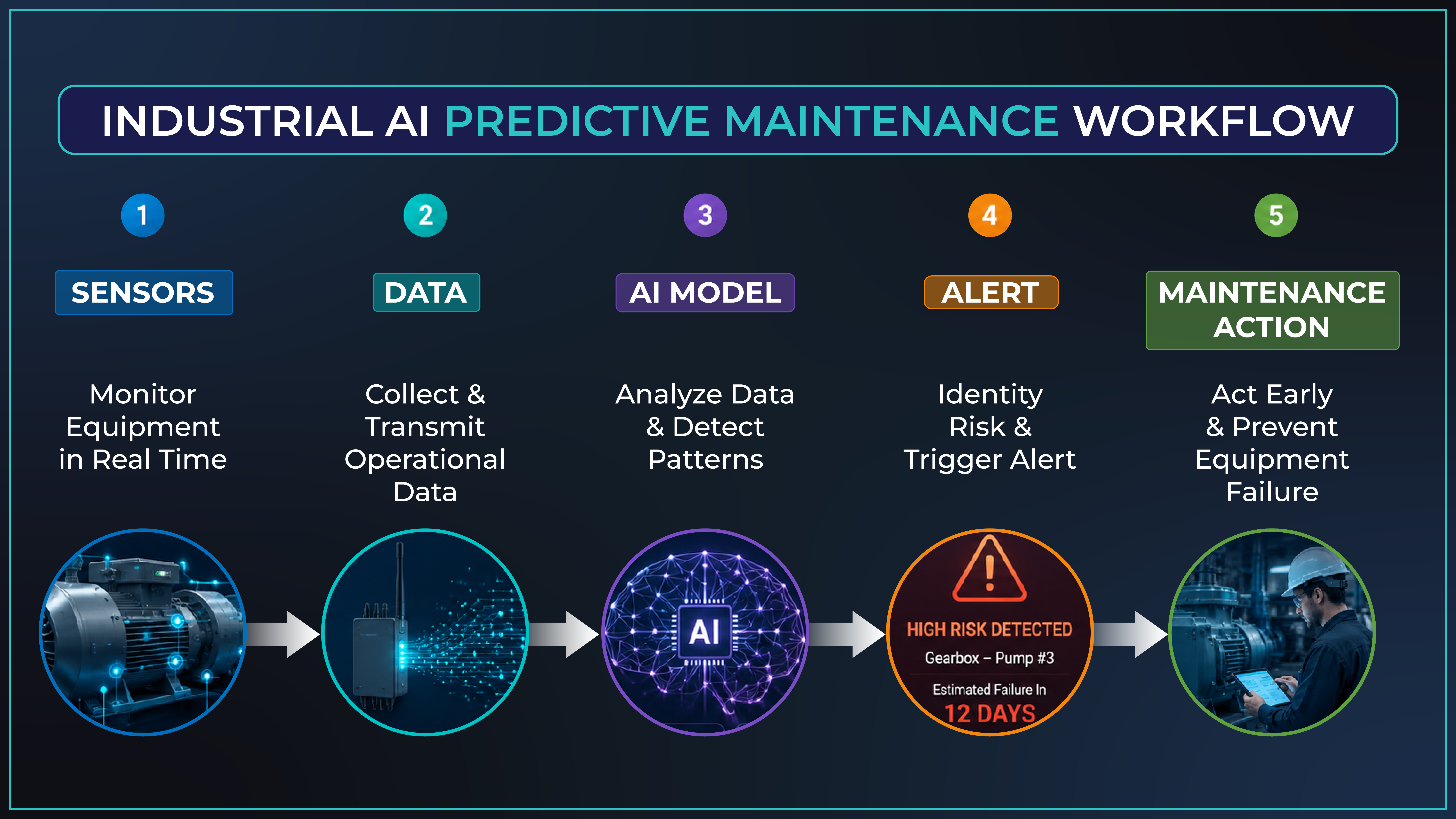
AI predictive maintenance software uses sensor data and machine‑learning models to assess equipment condition and flag developing failure risks.
Instead of relying only on:
- Time‑based inspections
- Fixed maintenance schedules
- Simple alarm thresholds
it learns what normal operation looks like and identifies patterns that indicate abnormal behaviour.
This matters because most industrial failures do not happen suddenly. Bearings wear, temperatures drift, vibrations increase, and efficiency drops long before a machine stops working. AI-based predictive maintenance systems are designed to detect these subtle changes early, giving maintenance teams time to respond in a controlled and planned manner.
Key Problems It Solves
1. Unplanned Downtime
Unexpected equipment failures can halt production, create safety hazards, and trigger costly emergency repairs. Predictive maintenance reduces these surprises by identifying warning signs early enough to plan intervention.
2. Over-Maintenance
Preventive maintenance often replaces parts that are still functional. AI predictive maintenance focuses on actual asset condition, reducing unnecessary servicing and spare part consumption.
3. Limited Visibility into Asset Health
Some faults cannot be seen during routine inspections. ML model can detect weak signals in vibration, temperature, pressure, or electrical data that indicate internal wear.
4. Poor Maintenance Prioritization
Without predictive insight, all issues compete for attention. AI-based systems help identify which assets carry the highest operational risk and need immediate action.
How It Works (High-Level Overview)
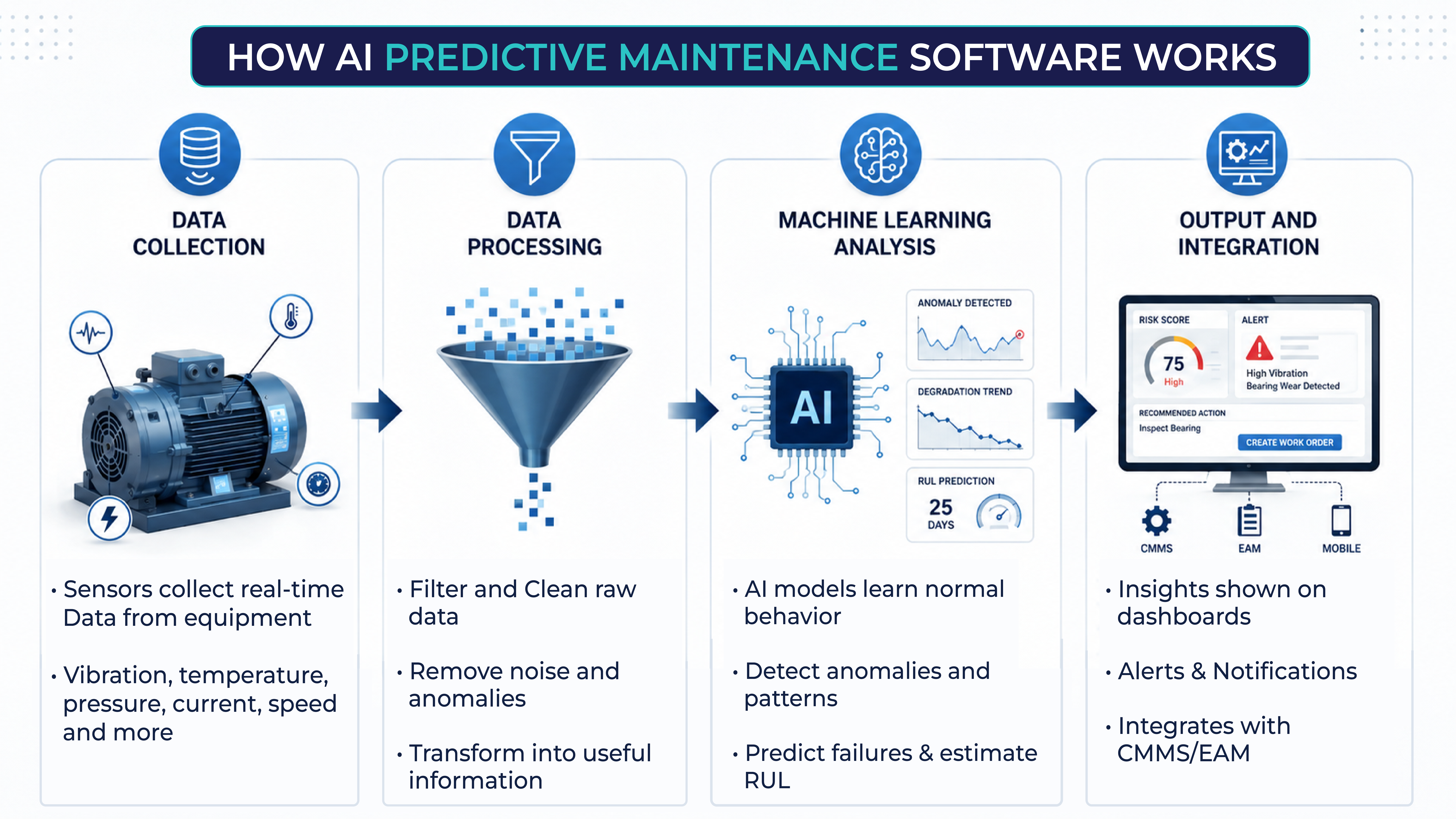
Data Collection
Data is gathered from sensors and control systems, including:
- vibration and acoustic signals
- temperature and pressure
- electrical current and voltage
- operational parameters such as speed or load
- environmental conditions (such as ambient temperature, humidity, and operating environment)
- control system data from PLCs and SCADA systems
- historical maintenance records and past failure data
Data Processing
Raw data is filtered, synchronized, and prepared for analysis. Noise and irrelevant signals are removed to ensure the model works with reliable inputs.
Machine Learning Analysis
The software learns normal operating patterns and compares new data against them. It can:
- detect anomalies
- track degradation trends
- estimate remaining useful life (RUL)
Output and Integration
Results surface through dashboards, alerts, or CMMS integration. This allows teams to act on predictions instead of raw sensor readings.
Core Features of AI Predictive Maintenance Software
- Continuous condition monitoring of equipment health
- Anomaly detection to identify unusual behaviour
- Failure prediction or risk scoring for assets
- Trend analysis for degradation tracking
- Integration with CMMS or asset management systems
- Visualization tools such as dashboards and reports
- Alerting mechanisms for early intervention
These features are designed to support operational decisions rather than replace engineering judgment.
Business and Operational Impact (ROI)
The ROI of AI predictive maintenance software typically comes from several sources:
Reduced Downtime
- Fewer emergency shutdowns
- Less production loss
- More stable operations
Lower Maintenance Costs
- Reduced spare part waste
- Less overtime labour
- Better maintenance planning
Extended Asset Life
- Fewer catastrophic failures
- Reduced secondary damage
- Improved long-term reliability
Improved Safety
- Fewer sudden breakdowns
- Reduced exposure to hazardous repairs
Benefits and Limitations
Benefits
- Early fault detection
- Data-driven maintenance decisions
- Scalable across multiple assets
- Continuous learning from new data
Limitations
- Requires good sensor coverage and data quality
- Needs time to learn normal operating behaviour
- Not all failures are predictable
- Integration with existing systems takes effort
AI does not replace maintenance expertise. It provides additional insight to support it.
Future Outlook
Key trends shaping AI predictive maintenance software include:
- increased use of edge computing for faster response
- integration with digital twins
- automated maintenance scheduling
- tighter links between maintenance and production planning systems
Future systems will focus not only on predicting failures but on optimizing entire asset fleets.
Conclusion
AI predictive maintenance software provides a practical way to improve equipment reliability and control maintenance costs. By combining sensor data with machine learning, it allows organizations to detect early signs of failure and act before disruptions occur.
For engineers, it improves visibility into asset condition.
For managers, it supports better planning and cost control.
For decision-makers, it offers measurable operational ROI.
The value lies not in the technology itself but in how effectively it is applied to real operational problems.
FAQ
1. What is AI predictive maintenance software?
It is software that uses machine learning and sensor data to predict equipment failures before they occur.
2. What equipment can use predictive maintenance?
Motors, pumps, compressors, turbines, CNC machines, generators, and many other industrial assets.
3. How accurate are predictive maintenance systems?
Accuracy depends on data quality, sensor coverage, and model training. Well-implemented systems can provide early warnings weeks in advance.
4. Is predictive maintenance expensive to implement?
Costs vary by asset scale and data availability. Many deployments achieve ROI through downtime reduction alone.
5. Does predictive maintenance replace technicians?
No. It supports technician