By Radome Team
|
November 26, 2026
Vibration Analysis: Methods, Benefits and Applications
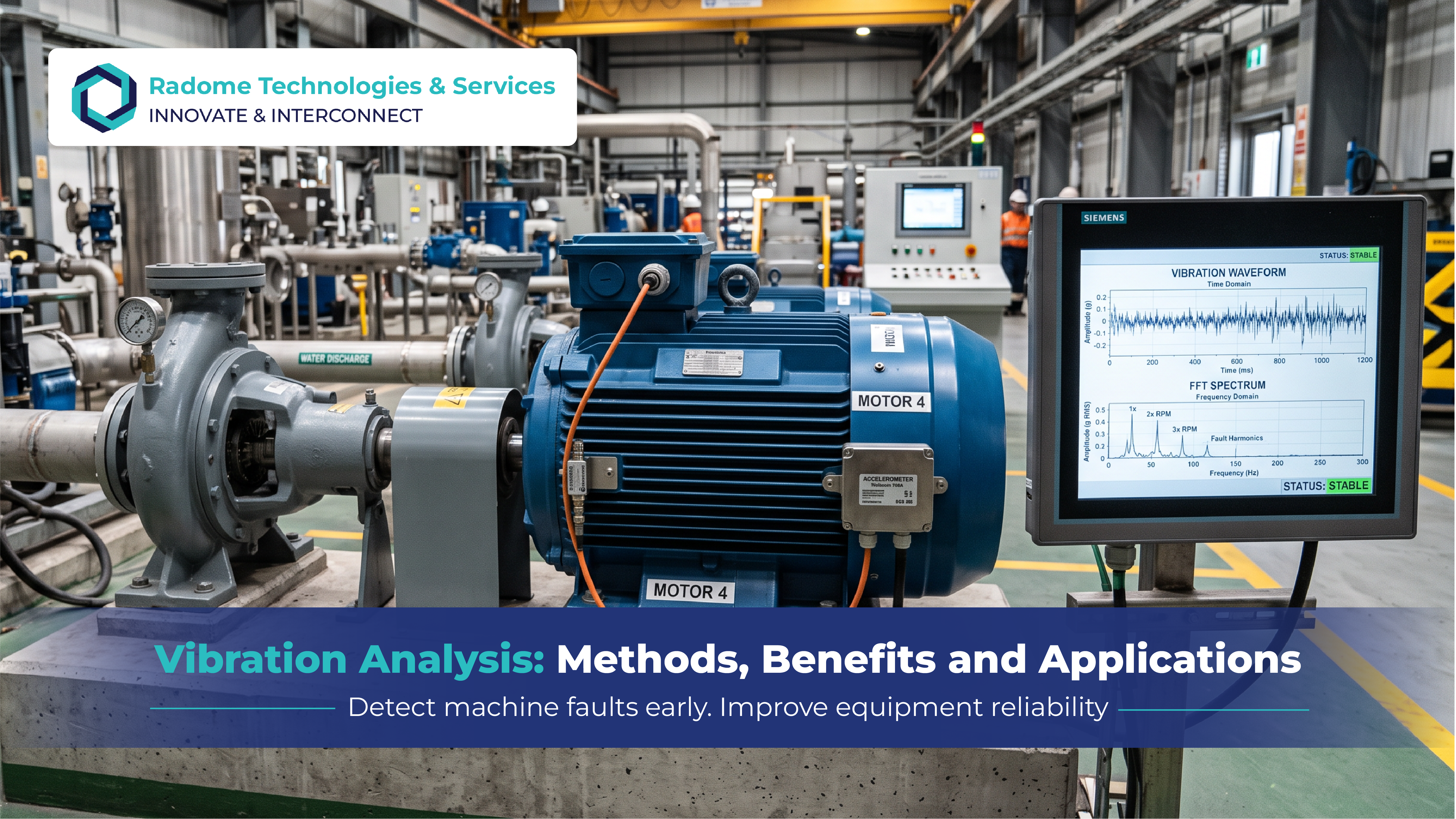
Industrial motors, pumps, compressors and gearboxes generate vibration during normal operation. However, changes in their vibration patterns can reveal developing mechanical problems such as imbalance, shaft misalignment and bearing defects.
Vibration analysis helps engineers measure and interpret these signals to understand equipment behaviour and investigate potential faults. By examining parameters such as vibration amplitude, frequency and waveform patterns, maintenance teams can identify abnormalities and make more informed maintenance decisions.
As industrial facilities increasingly rely on data to manage equipment reliability, vibration analysis plays an important role in machine monitoring, asset health monitoring and predictive maintenance.
What Is Vibration Analysis and Why Does It Matter?
Vibration analysis is the process of measuring the movement of machinery and examining its vibration patterns to assess equipment health. Every operating machine produces some level of vibration. The characteristics of this vibration depend on factors such as machine speed, load, component design and operating conditions.
When a component begins to wear or develop a fault, its vibration characteristics may change. These changes can appear in vibration amplitude, frequency, waveform patterns or other measurable parameters.
For example, an imbalance in a rotating motor can produce a noticeable vibration pattern linked to its rotational speed.
A developing bearing defect may generate repetitive impacts that become visible through more detailed vibration signal analysis.
Vibration analysis is particularly useful for rotating equipment, including:
- Electric motors and motor-driven systems
- Industrial pumps and compressors
- Gearboxes and turbines
- Fans, blowers and production machinery
It forms an important part of vibration condition monitoring and predictive maintenance, helping teams move from periodic inspections towards decisions informed by equipment performance data.
Key Problems Vibration Analysis Helps Solve
Mechanical problems often develop gradually. Without consistent monitoring, maintenance teams may identify them only after equipment performance has deteriorated.
Vibration analysis helps investigate several common issues:
- Motor imbalance: Uneven mass distribution in rotating components can cause excessive vibration.
- Shaft misalignment: Incorrect alignment between connected shafts can increase vibration and coupling stress.
- Bearing defects: Wear or surface damage can produce repetitive vibration patterns.
- Mechanical looseness: Loose mounting points or internal components can introduce abnormal vibration.
- Gearbox problems: Damaged gear teeth and irregular meshing can generate characteristic vibration patterns.
Vibration analysis helps engineers investigate these issues by examining the frequency, amplitude and pattern of machine vibration
How Vibration Analysis Works
A typical vibration analysis system follows a sequence of measurement, processing, interpretation and action.
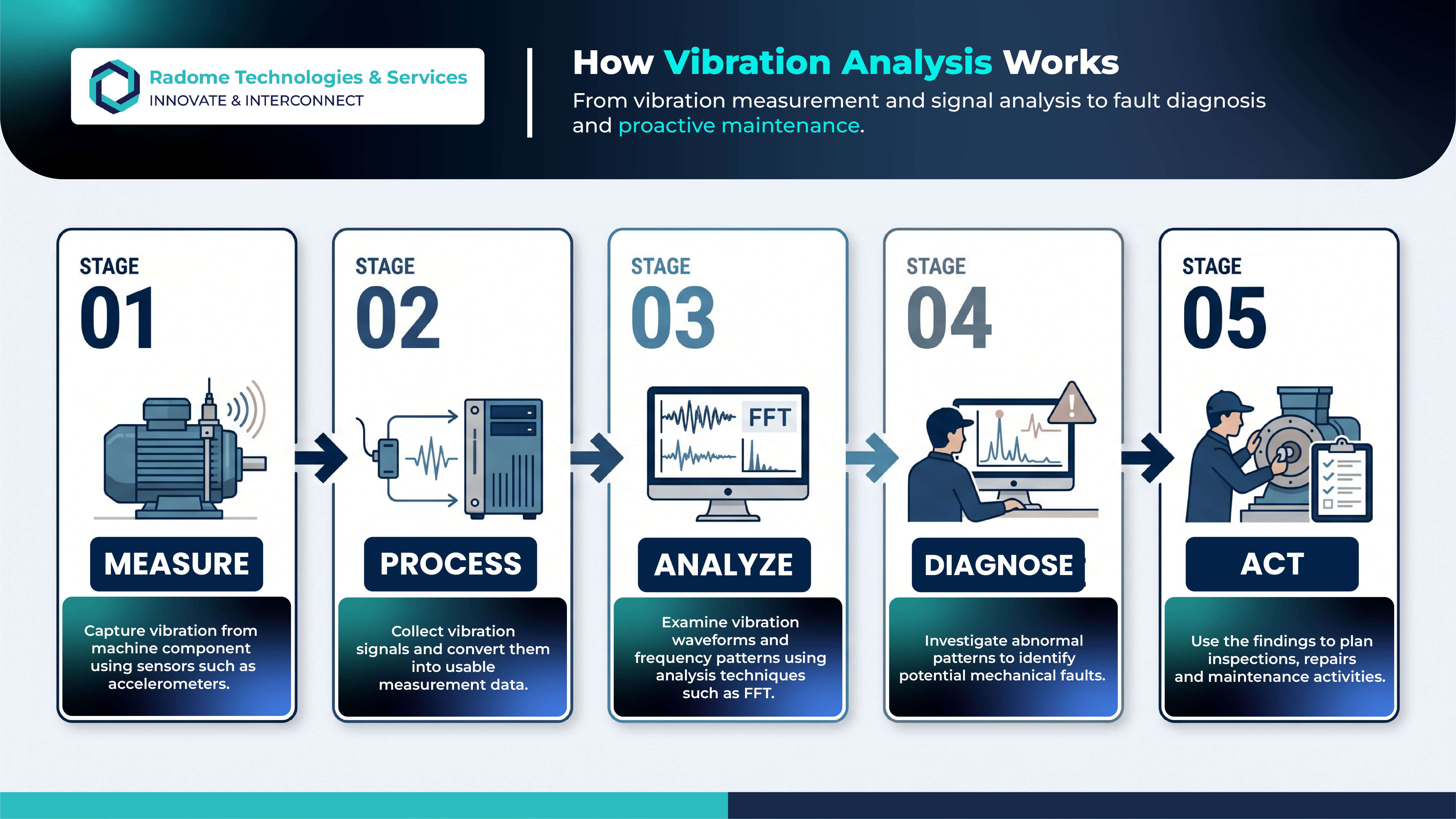
1. Vibration Measurement and Data Collection
The process begins by selecting suitable measurement points on the machine. Sensors are positioned near components such as bearings, motor housings or machine supports, depending on the equipment design and monitoring objective.
An accelerometer is commonly used to measure vibration acceleration. Other instruments, including velocity sensors and displacement probes, are used depending on the application and frequency range.
The collected signals are transferred to a data acquisition device or monitoring platform for further analysis.
2. Understanding Vibration Parameters
Three important parameters help describe mechanical vibration:
- Amplitude: Indicates the magnitude of vibration and helps track changes in machine behaviour over time.
- Frequency: Represents how frequently the vibration repeats, measured in Hertz (Hz). It helps identify patterns associated with rotating speeds and mechanical faults.
- Phase: Describes the relative timing between vibration signals measured at different points. Phase comparison can help engineers investigate conditions such as imbalance and shaft misalignment.
The appropriate measurement parameter also depends on the equipment and the type of fault being investigated:
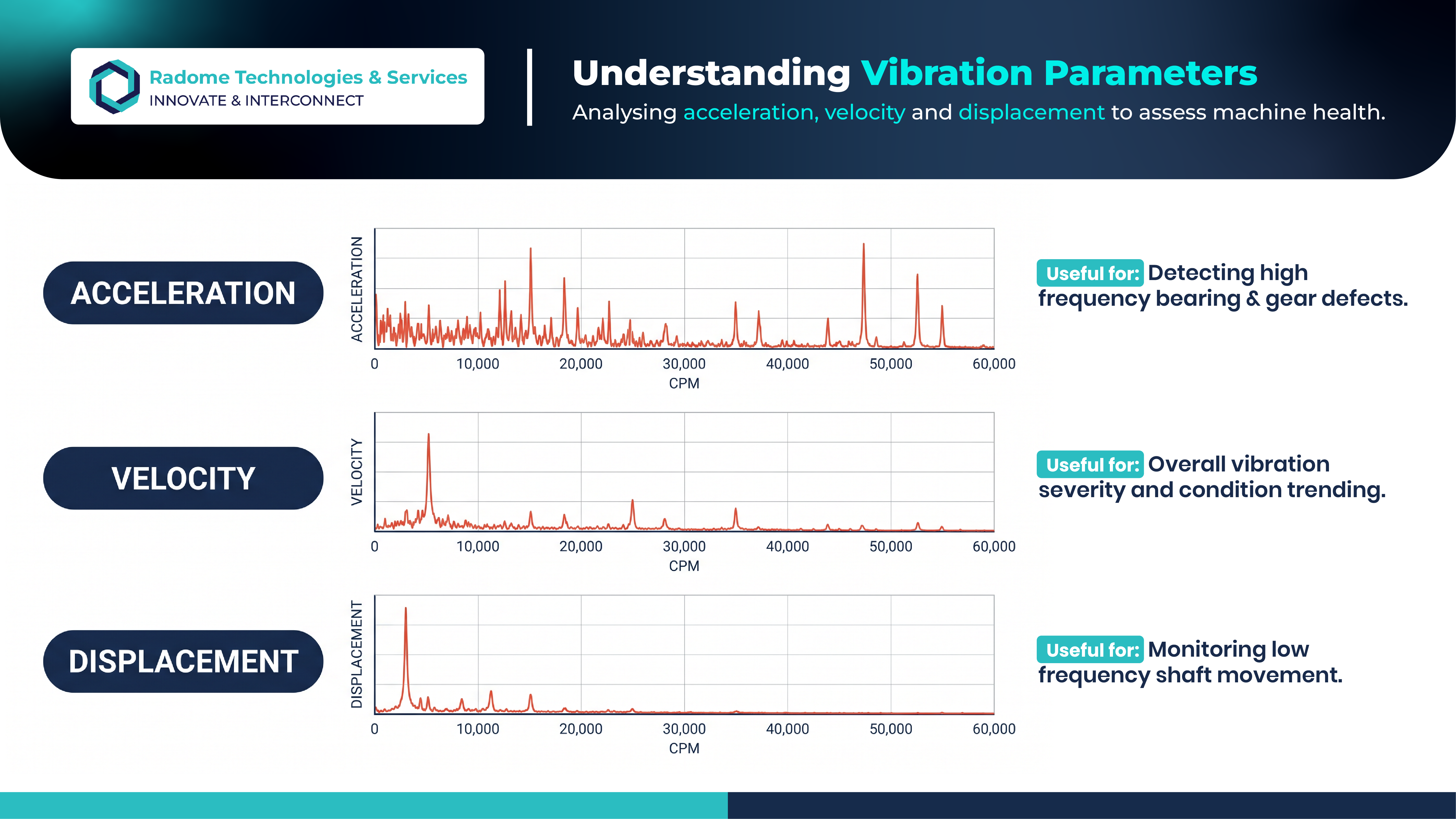
- Vibration velocity is commonly used for assessing and trending overall vibration levels across many industrial rotating machines.
- Vibration acceleration is useful for analysing higher-frequency signals, particularly those associated with bearing and gear defects.
- Vibration displacement is useful for evaluating low-frequency shaft movement, often measured using proximity probes in applicable machinery.
Each parameter provides a different perspective on machine behaviour. Selecting the appropriate one helps ensure that the collected data is relevant to the equipment and monitoring objective.
3. Applying Vibration Analysis Methods
Different mechanical faults produce different vibration patterns. Engineers analyse these patterns using techniques such as time-domain analysis, frequency-domain analysis, FFT and envelope analysis.
- Time-domain analysis: Examines vibration waveforms over time to identify impacts, sudden changes and irregular patterns.
- Frequency-domain analysis: Breaks down vibration signals into individual frequency components to help identify possible mechanical faults.
- Fast Fourier Transform (FFT): Converts time-domain signals into a frequency spectrum, helping engineers identify dominant frequencies and harmonics.
- Envelope analysis: Helps detect repetitive, high-frequency impacts associated with developing rolling-element bearing defects.
These techniques help engineers investigate common mechanical problems in rotating equipment.
| Mechanical fault |
Typical vibration indicator |
Analysis technique |
| Rotor imbalance |
Dominant vibration at 1X running speed, often radial |
FFT and phase analysis |
| Shaft misalignment |
Axial or radial vibration, sometimes with 2X components and harmonics |
FFT and phase analysis |
| Mechanical looseness |
Multiple harmonics and irregular waveform patterns |
FFT and time-domain analysis |
| Bearing defects |
Repetitive impacts at characteristic bearing frequencies |
Envelope analysis |
| Gear wear or damage |
Gear-mesh frequency components and sidebands |
FFT and time-domain analysis |
| Resonance |
Increased vibration near a machine's natural frequency |
Impact testing and operating-speed analysis |
Note: These are typical indicators, not definitive fault signatures. Actual patterns depend on machine design, speed, load and sensor position.
4. Interpreting Results and Identifying Faults
Vibration diagnostics involves comparing measured patterns with equipment baselines, historical trends and operating conditions.
For example, a prominent 1X running-speed component may indicate rotor imbalance. However, engineers must consider other factors, including machine speed, load and phase measurements, before identifying the cause.
Vibration analysis software can support this process by examining frequency spectra, tracking vibration trends and identifying deviations from established equipment baselines.
5. Taking Maintenance Action
Once an abnormal pattern is identified, the maintenance team investigates the equipment, assesses the potential risk and determines the appropriate corrective action.
This may involve balancing a rotor, realigning a coupling, inspecting bearings or checking mounting points. The objective is to use vibration insights to support timely maintenance decisions and reduce the likelihood of unexpected equipment failure.
Practical Applications of Vibration Analysis
Vibration analysis is widely applicable wherever rotating machinery plays an important role in production or operations.
| Equipment |
Typical monitoring focus |
| Electric motors |
Imbalance, bearing defects and mechanical looseness |
| Industrial pumps |
Bearing wear, misalignment and abnormal operating vibration |
| Compressors |
Rotating component behaviour, bearing issues and vibration trends |
| Gearboxes |
Gear-meshing patterns, wear and damaged components |
| Fans and blowers |
Imbalance, alignment and bearing condition |
| Turbines |
Shaft vibration, bearing behaviour and operating stability |
For example, in a manufacturing plant, motor vibration monitoring can help identify an increase in vibration levels before a motor develops a more serious mechanical problem. Maintenance teams can investigate the motor, check alignment or inspect its bearings before deciding on corrective action.
Similarly, pump vibration analysis can help identify changes in equipment behaviour that may require further investigation.
Business and Operational Impact
Vibration analysis helps maintenance teams identify developing equipment issues and make better-informed maintenance decisions. Its key operational benefits include:
- Early fault detection: Identifies abnormal vibration patterns that may indicate developing mechanical faults.
- Reduced downtime: Helps teams investigate potential issues before they cause unexpected equipment interruptions.
- Better maintenance planning: Supports prioritising inspections and repairs based on equipment health.
- Improved reliability: Helps maintain the performance of critical industrial machinery.
However, vibration analysis has limitations. Not all mechanical, electrical or process-related problems produce detectable vibration signals, particularly in their early stages. Sensor placement, operating conditions and measurement consistency can also affect the results. Combining vibration data with other equipment parameters and inspection findings provides a more complete view of asset health.
A real-world example comes from a pulp and paper manufacturing facility, where vibration monitoring detected rising acceleration levels in a vacuum pump motor bearing. Further analysis indicated insufficient lubrication, allowing the maintenance team to intervene before failure.
According to the Waites case study, the intervention helped avoid 16 hours of downtime and approximately $313,936 in potential costs. It demonstrates how vibration monitoring can support early fault detection and prevent production disruptions.
Future of Vibration Analysis in Industrial AI
Traditional vibration analysis often involves periodic measurements and specialist interpretation. Industrial AI is creating opportunities to analyse vibration data more consistently, particularly across large equipment fleets and complex production environments.
Three developments are shaping this approach:
Automated equipment baselining: AI models can learn normal vibration patterns for individual machines and account for variations in operating speed and load. This helps establish more relevant baselines for identifying abnormal behaviour.
Spectral pattern recognition: Machine learning techniques can analyse vibration spectra and historical signals to identify recurring patterns associated with mechanical abnormalities. These insights can support engineers during fault investigation.
Smarter alert prioritisation: By evaluating vibration trends alongside other operating parameters, monitoring platforms can help distinguish significant deviations from routine variations. This can reduce unnecessary alerts and direct attention towards equipment that requires investigation.
These capabilities do not replace engineering judgement. They make it easier to process equipment data, identify patterns and prioritise maintenance decisions across industrial assets.
Final Thoughts
Vibration analysis helps maintenance teams identify potential mechanical issues, improve maintenance planning and maintain equipment reliability. When combined with other machine operating parameters, it provides a broader understanding of equipment health and performance.
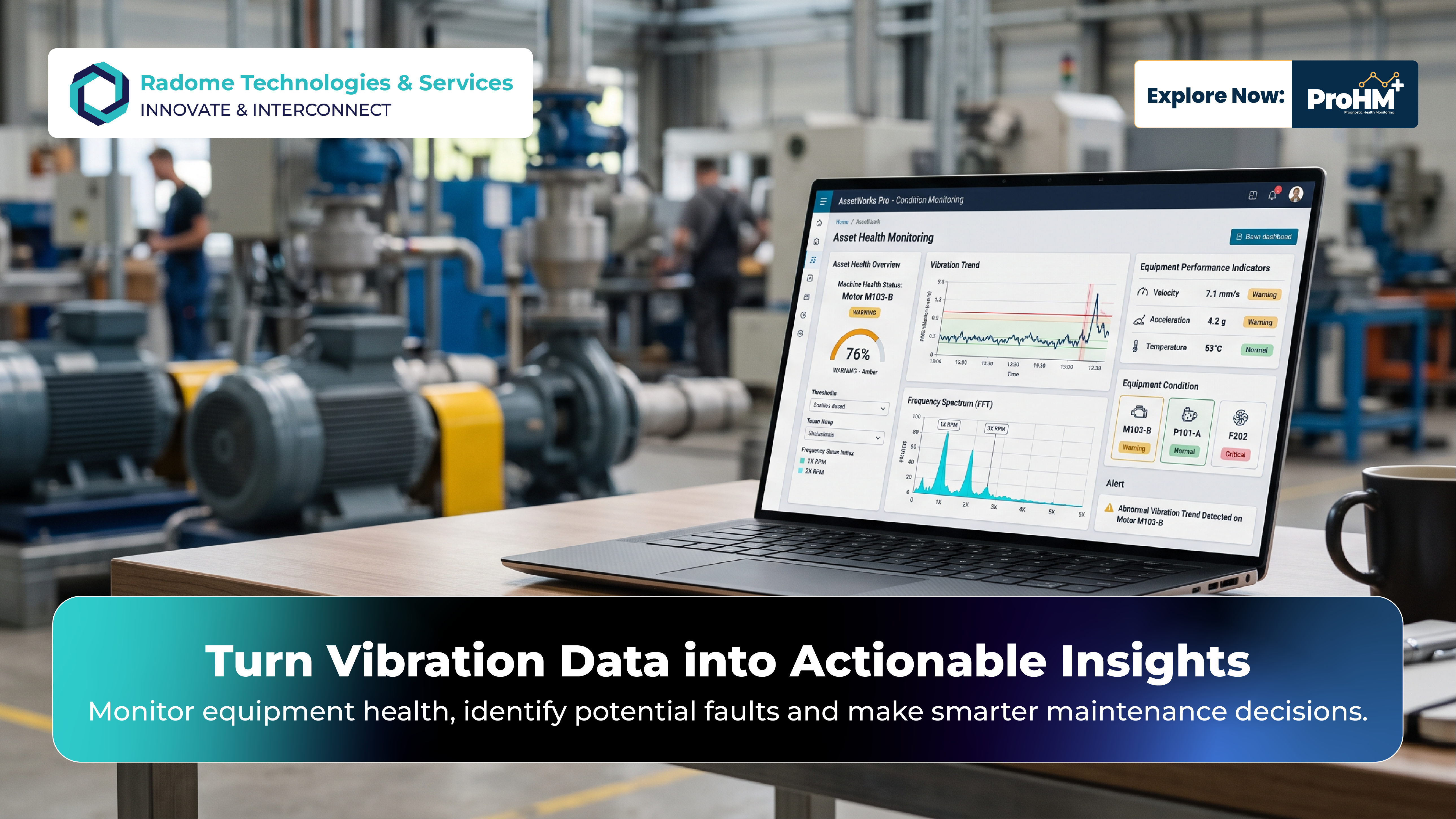
As industrial operations become more data-driven, having the right insights into equipment behaviour becomes increasingly important. With ProHM+, Radome Technologies helps industries strengthen asset health monitoring through data-driven insights. Explore ProHM+ to learn more.
Frequently Asked Questions
1. What is vibration analysis used for?
Vibration analysis is used to assess the mechanical health of equipment by measuring and interpreting vibration patterns. It helps identify issues such as imbalance, shaft misalignment, bearing defects and mechanical looseness.
2. What are the main methods of vibration analysis?
Common methods include time-domain analysis, frequency-domain analysis, FFT analysis and envelope analysis. Each method provides different information about machine behaviour and potential faults.
3. What equipment is used for vibration analysis?
Common vibration analysis equipment includes accelerometers, velocity sensors, displacement sensors, vibration meters, data collectors and vibration analysis software.
4. What is the difference between vibration monitoring and vibration analysis?
Vibration monitoring involves measuring and tracking machine vibration over time. Vibration analysis goes further by examining the collected signals to understand abnormal patterns and investigate possible mechanical faults.
5. Can vibration analysis detect bearing failures?
Yes. Vibration analysis can help identify developing bearing defects by examining characteristic vibration patterns. Techniques such as envelope analysis are particularly useful for detecting repetitive impacts associated with early stage bearing damage.
6. How does vibration analysis support predictive maintenance?
It helps maintenance teams identify changes in machine behaviour, assess potential mechanical problems and prioritize inspections or repairs before a fault leads to equipment failure. Its effectiveness improves when vibration data is evaluated alongside operating conditions and historical trends.