By Radome Team
|
October 28, 2026
How to Implement Predictive Maintenance: A Step-by-Step Guide for Industrial Assets
Industrial assets continuously generate signals about their health. Changes in vibration, temperature, pressure, and energy consumption can provide early indicators of equipment degradation long before a failure occurs. The challenge is transforming these signals into actionable insights that maintenance teams can use to prevent disruptions.
And the need to act early is becoming harder to ignore. A 2025 ABB study of 3,600 industry decision-makers found that 44% of organizations experience equipment-related interruptions at least monthly, while 14% face them every week.
This puts increasing pressure on industrial organizations to improve equipment reliability while controlling maintenance costs and unplanned downtime. Traditional approaches, such as reactive repairs and fixed preventive schedules, can work well for some assets, but they may not provide enough visibility into how equipment is performing.
This is where predictive maintenance becomes valuable.
Predictive maintenance uses asset data, monitoring technologies, analytics, and AI to identify changes in equipment behaviour and support maintenance decisions before failures become disruptive.
However, implementing predictive maintenance is not simply a matter of installing sensors or purchasing software. A successful predictive maintenance program requires a clear strategy, reliable data, appropriate technology, engineering knowledge, and integration with existing maintenance workflows.
What Is Predictive Maintenance Implementation?
Predictive maintenance implementation is the process of introducing data-driven monitoring and analytics into maintenance operations to identify potential equipment problems early and support better maintenance decisions.
A typical predictive maintenance program combines asset monitoring, operational data, historical maintenance records, predictive analytics, machine learning, anomaly detection, asset health assessment, and maintenance workflows.
The objective is not to predict every failure with complete certainty. Instead, predictive maintenance provides maintenance teams with better information about which assets may require attention and when intervention may be appropriate.
How to Implement Predictive Maintenance
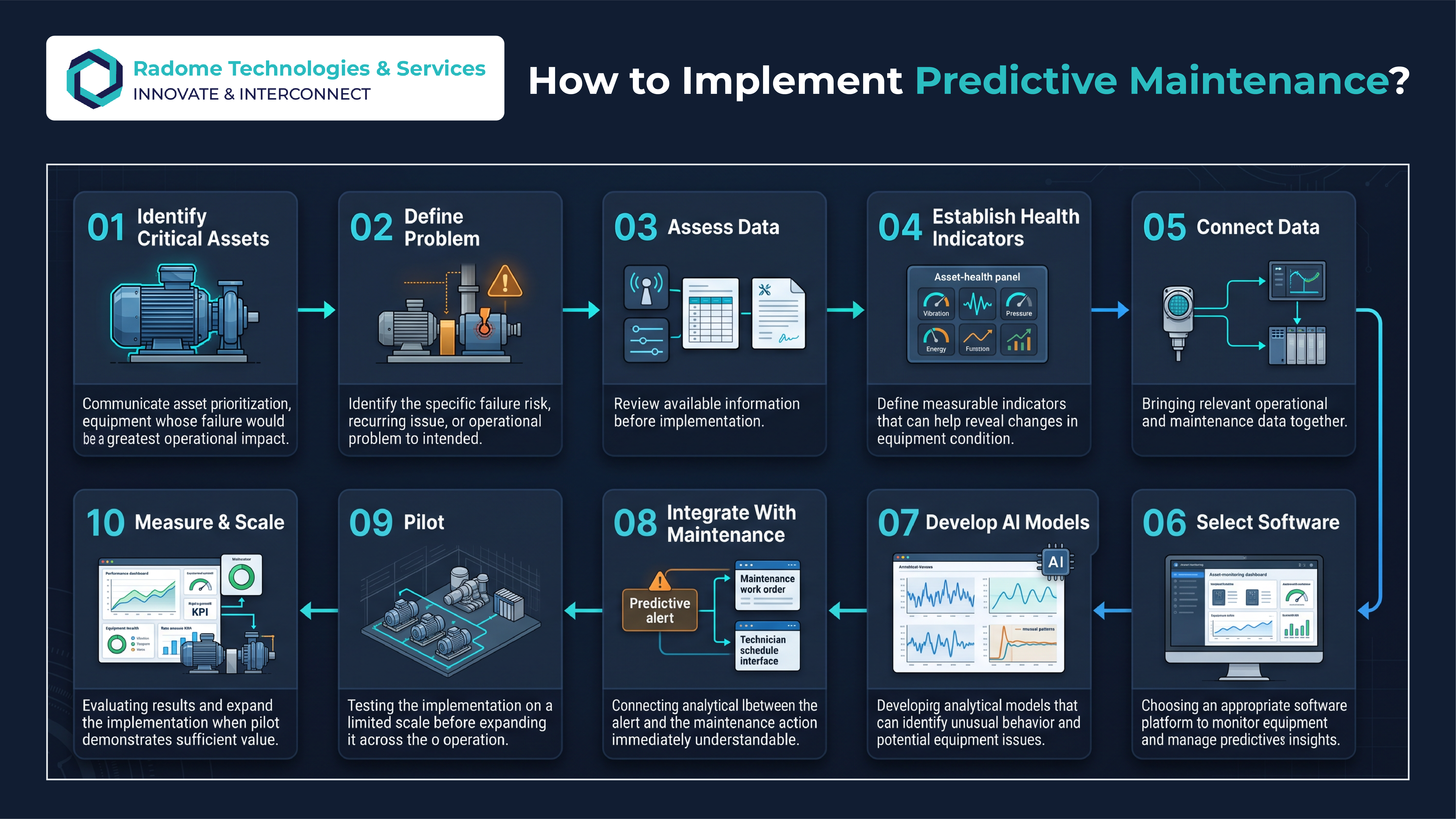
1. Identify Critical Assets
The first step in implementing predictive maintenance is to identify which assets have the greatest impact on operational performance. Not every asset needs the same level of predictive monitoring. Evaluate equipment based on:
- Production impact
- Safety implications
- Failure frequency
- Maintenance and replacement cost
- Effect on downstream operations
- Historical failure patterns
Critical motors, compressors, turbines, and pumps may deserve greater monitoring attention than assets with minimal operational impact.
Starting with critical assets also makes it easier to demonstrate value through a focused pilot.
2. Define the Maintenance Problem
Once critical assets have been identified, clearly define the problem the organization wants to solve.
For example:
- A critical motor experiences repeated bearing failures.
- A production line suffers unexpected stoppages.
- Maintenance teams receive too many alarms.
- Equipment is being maintained more frequently than necessary.
- Engineers have limited visibility into asset health.
A clear objective gives the predictive maintenance plan a measurable direction.
Instead of starting with "Where can we use AI?", start with:
Which maintenance problem is creating the greatest operational impact?
This helps ensure that the predictive maintenance implementation is driven by an actual operational need rather than technology alone.
3. Assess Available Data
Data is the foundation of predictive maintenance.
Before deploying a predictive maintenance system, determine what information is already available.
This may include:
- Sensor data
- Equipment operating parameters
- Historical maintenance records
- Failure history
- Inspection reports
- Production data
- Operating hours
- Temperature and pressure data
- Vibration measurements
- Energy consumption
- Alarm records
The quality of the data matters more than simply having large volumes of it.
If maintenance records are incomplete or sensor data is inconsistent, the organization may need to address those issues before developing reliable predictive models.
4. Establish Asset Health Indicators
Once the available data is understood, determine which parameters provide meaningful information about asset health.
Different equipment requires different indicators.
| Asset |
Potential Indicators |
| Motor |
Vibration, temperature, current |
| Pump |
Pressure, flow rate, vibration |
| Compressor |
Temperature, pressure, vibration |
| Turbine |
Temperature, vibration, operating parameters |
| Production equipment |
Energy consumption, cycle time, vibration |
The objective is not to monitor everything.
It is to identify the signals that can help distinguish normal equipment behavior from potentially abnormal behavior.
5. Connect Data Sources and Monitoring Systems
The next stage is connecting relevant operational data.
Industrial environments may contain information across:
- IoT sensors
- PLCs
- SCADA systems
- CMMS and EAM platforms
- ERP systems
- Inspection systems
- Maintenance databases
This is where system integration becomes important.
A predictive maintenance system should consolidate relevant asset and operational data into a single environment that supports monitoring and decision-making.
The integration approach will depend on the existing industrial infrastructure, data formats, communication protocols, and maintenance systems.
6. Select the Right Predictive Maintenance Software
The technology should support the maintenance problem identified at the beginning.
Depending on the application, predictive maintenance software may provide capabilities such as:
- Asset health monitoring
- Data ingestion
- Predictive analytics
- Machine learning
- Anomaly detection
- Failure prediction
- Alerts and notifications
- Asset dashboards
- Maintenance recommendations
- CMMS or EAM integration
The right solution is not necessarily the platform with the most features. Instead, it should align with the organization's assets, data environment, existing systems, and maintenance workflows.
When evaluating predictive maintenance software, consider:
- Data integration capabilities
- AI and analytics capabilities
- Scalability
- Asset coverage
- System compatibility
- Alert management
- Dashboard and reporting capabilities
- Integration with maintenance workflows
- Ease of deployment and use
Platforms such as Radome Technologies' ProHM+ are designed to support these requirements by combining asset health monitoring, predictive analytics, and maintenance workflow integration within a unified platform.
7. Develop and Validate Predictive Models
This is where artificial intelligence and machine learning can become useful.
Predictive models use historical and operational data to identify patterns associated with asset degradation, abnormal operating conditions, and potential failures.
A simplified predictive maintenance process flow looks like this:
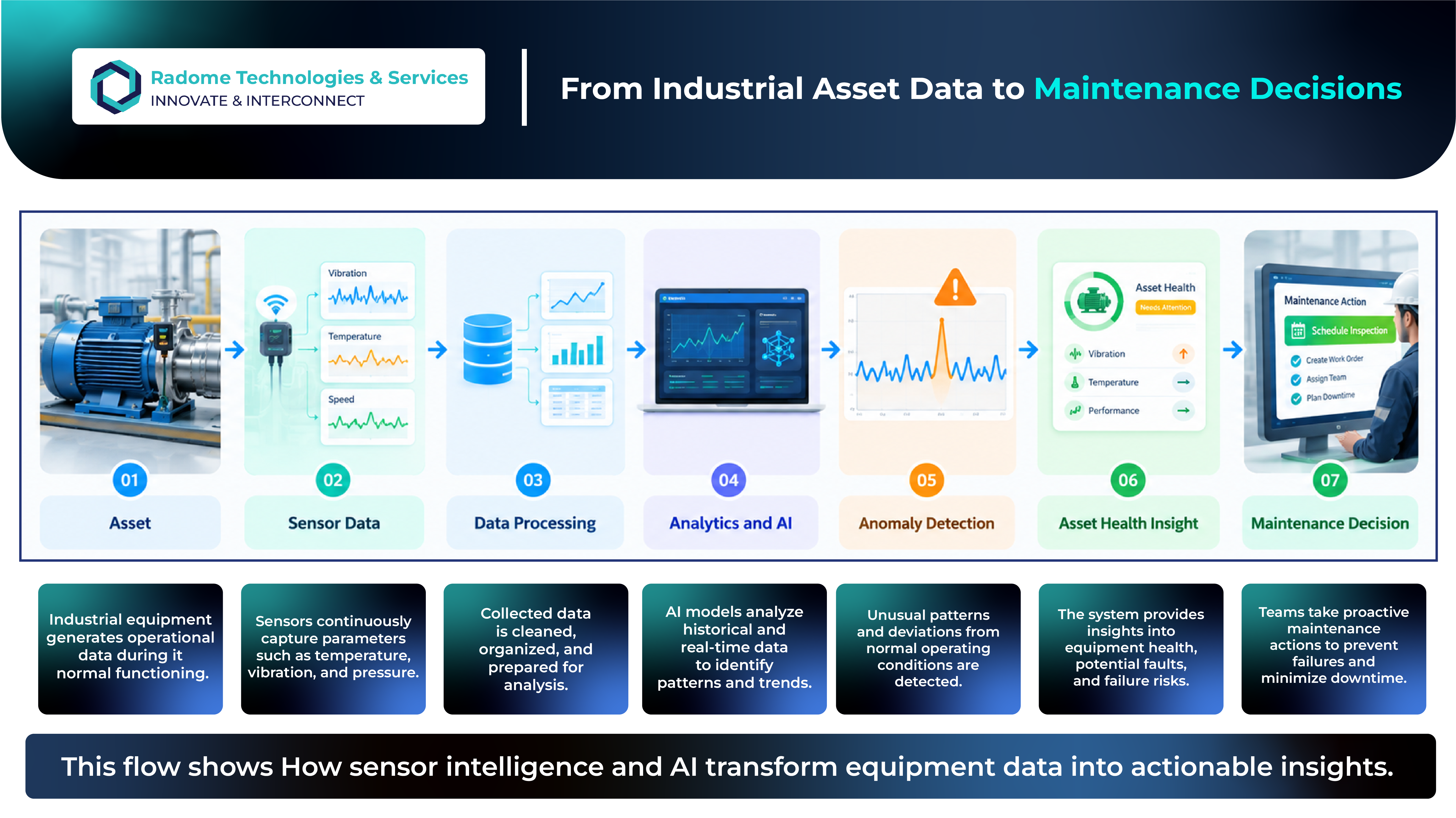
For example, if vibration data from a critical motor begins deviating from its normal operating pattern, an anomaly detection model can flag the change. Engineers can then investigate whether it indicates bearing wear or another developing issue.
Models should be validated against engineering knowledge and historical equipment behaviour before being used to support maintenance decisions. Their performance should also be monitored as operating conditions change.
8. Integrate Insights into the Maintenance Workflow
An alert alone does not improve equipment reliability.
The organization needs a clear maintenance workflow for responding to predictive insights.
A typical process may be:
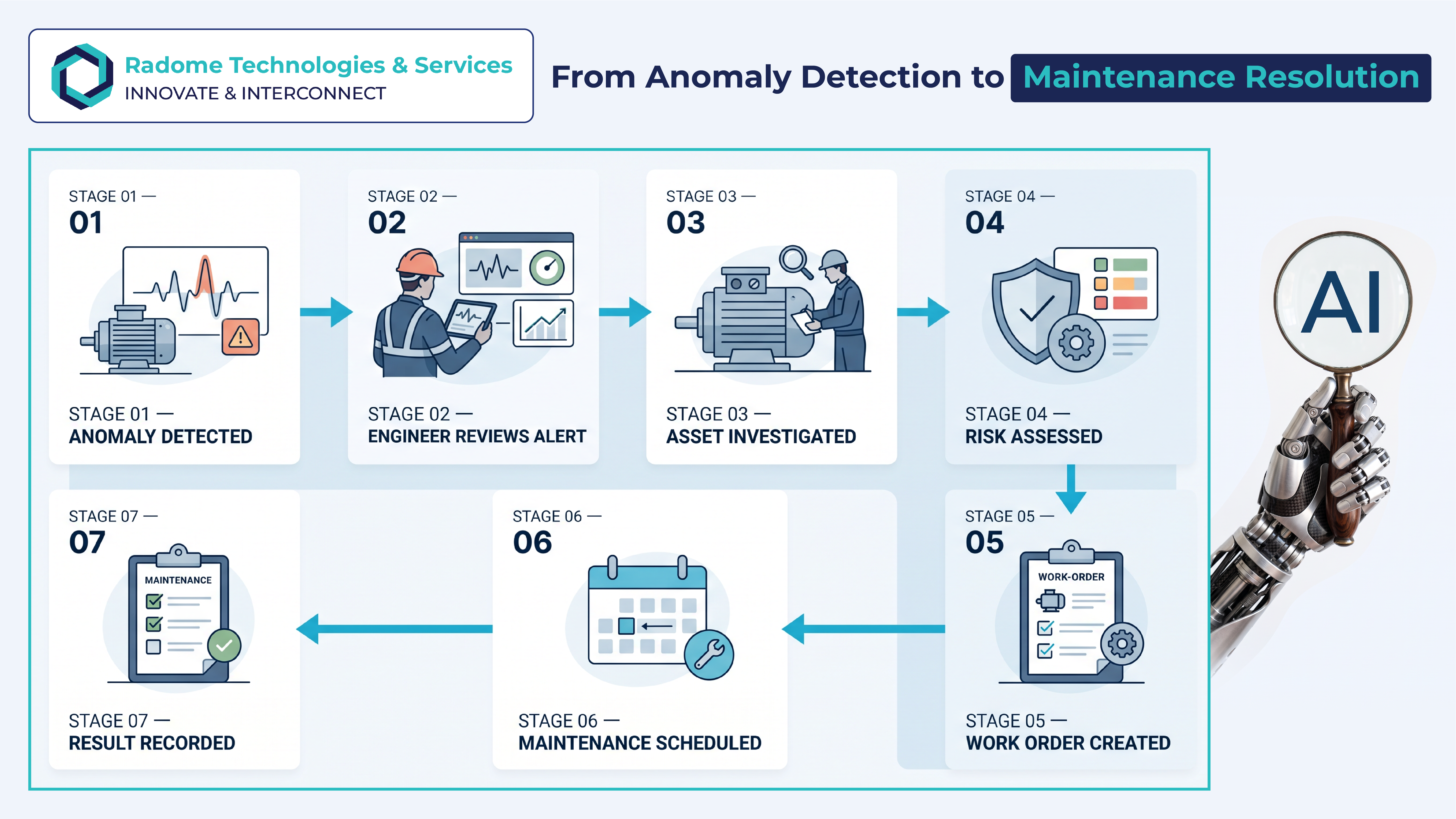
Integration with CMMS or EAM systems can connect predictive insights with existing maintenance processes.
Teams should clearly define who reviews alerts, how they are prioritized, when inspections or work orders are required, and how maintenance outcomes are recorded.
9. Start With a Pilot Predictive Maintenance Program
Organizations do not need to deploy predictive maintenance across an entire facility immediately.
A focused pilot can begin with:
- Critical or high-value assets
- Equipment with recurring failures
- One production line
- Assets with significant downtime impact
During the pilot, evaluate metrics such as unplanned downtime, failure frequency, maintenance response time, false alerts, and asset availability.
The results can then be used to refine the program before expanding to additional assets.
10. Measure Results and Scale
Once the pilot demonstrates value, the organization can gradually expand predictive maintenance to other assets and production areas.
Scaling should consider:
- Asset criticality
- Data availability
- Model performance
- Maintenance team capacity
- Integration requirements
- Business impact
- Cost of implementation
The goal is not simply to increase the number of monitored assets.
The objective is to expand predictive maintenance where it can provide meaningful operational value.
Common Predictive Maintenance Implementation Challenges
A predictive maintenance strategy can face several practical challenges.
Poor Data Quality
Incomplete maintenance records, inconsistent sensor readings, or missing historical data can affect analytics and model performance.
Limited Failure Data
Some assets fail infrequently, making it difficult to build models based only on historical failures. In these situations, anomaly detection and normal-behaviour modelling can be useful approaches.
Legacy System Integration
Industrial facilities may operate equipment and systems from different generations and vendors. Connecting these environments can require additional integration work.
False Alerts
Too many alerts can lead to alarm fatigue. Models need to be evaluated and refined so that maintenance teams receive information that is relevant and actionable.
Lack of Workflow Integration
If predictive insights remain separate from maintenance processes, teams may struggle to act on them.
Scaling Too Quickly
Trying to implement predictive maintenance across every asset at once can increase complexity. A focused implementation is often easier to manage and measure.
Practical Applications of Predictive Maintenance
Predictive maintenance can be applied across asset-intensive industries.
Manufacturing
Monitor motors, pumps, compressors, conveyors, CNC machines, and production equipment to identify abnormal behaviour and support maintenance planning.
Process Industries
Use operational and equipment data to monitor critical process equipment and identify changes that may affect production reliability.
Aviation
Aircraft health monitoring and flight data can support the identification of abnormal equipment behavior and maintenance-related issues.
Automotive
Predictive analytics can support equipment reliability across production lines, particularly where unexpected equipment downtime can interrupt manufacturing.
The implementation principles remain similar, although the data sources, asset health indicators, and maintenance requirements differ by industry.
How to Measure Predictive Maintenance Success
A successful implementation should be measured using operational outcomes rather than the number of sensors or AI models deployed.
Useful KPIs include:
- Reduction in unplanned downtime
- Asset availability
- Mean time between failures
- Maintenance cost
- Planned versus reactive maintenance
- Failure detection lead time
- Number of actionable alerts
- Maintenance response time
- Cost avoided through early intervention
The right metrics depend on the original business problem.
For example, if the main objective is reducing unexpected production stoppages, unplanned downtime and asset availability may be more relevant than the number of predictive alerts generated.
Key Takeaways
How to implement predictive maintenance is ultimately a process of connecting technology with maintenance strategy and operational requirements.
The most effective approach is to:
- Identify critical assets.
- Define the maintenance problem.
- Assess available data.
- Establish meaningful asset health indicators.
- Connect relevant data sources.
- Select appropriate predictive maintenance software.
- Develop and validate analytics models.
- Integrate insights into maintenance workflows.
- Start with a focused pilot.
- Measure results and scale progressively.
Predictive maintenance works best when data, AI, engineering expertise, and maintenance processes work together. Technology provides the insight, but maintenance teams turn those insights into action.
Radome Technologies' ProHM+ helps organizations connect asset health monitoring, predictive analytics, and maintenance workflows to support more informed maintenance decisions. Connect with Radome Technologies to explore your predictive maintenance requirements.
Frequently Asked Questions
1. How do you implement predictive maintenance?
Start by identifying critical assets and the maintenance problems you want to solve. Then assess available data, establish asset health indicators, connect data sources, select suitable software, develop and validate predictive models, integrate insights into maintenance workflows, run a pilot, and scale based on measured results.
2. What is a predictive maintenance program?
A predictive maintenance program is a structured approach that uses equipment data, monitoring, analytics, and predictive techniques to identify potential asset problems and support proactive maintenance decisions.
3. What data is needed for predictive maintenance?
Common data sources include sensor readings, equipment operating parameters, maintenance records, failure history, inspection data, production information, and other operational data relevant to asset health.
4. What are the main challenges of predictive maintenance implementation?
Common challenges include poor data quality, insufficient failure history, legacy-system integration, false alerts, limited technical expertise, and difficulty integrating predictive insights into existing maintenance workflows.
5. How does AI help with predictive maintenance?
AI and machine learning can analyze historical and real-time equipment data to identify patterns, detect abnormal behavior, assess asset health, and support the identification of potential equipment problems.
6. Should predictive maintenance be implemented across all assets?
Not necessarily. A focused approach usually makes more sense. Organizations can begin with critical or high-value assets where equipment failure has a significant operational or financial impact, then expand the program based on results.